 Turkey (Türkçe)

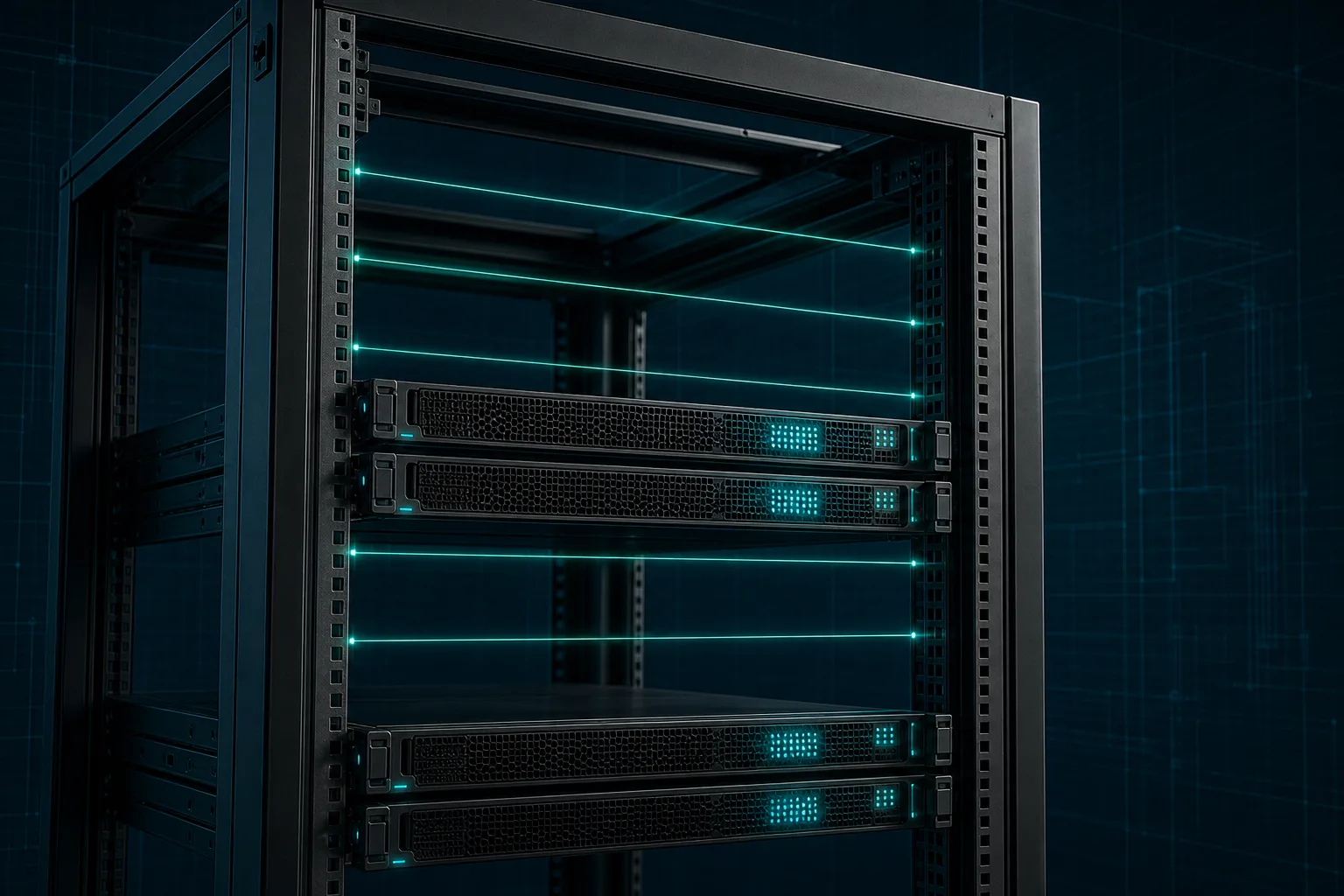
The first sticking point for teams that decide to rent a rack is choosing the size: is 10U enough, or should you take 21U? A wrong calculation is costly in both directions. Choose too small and you face moving costs six months later; choose too big and you pay for space you do not use. This guide explains the rack unit (U) concept, standard rack dimensions and how to correctly calculate the number of U you need.
U is the abbreviation of "rack unit" and is sometimes written as RU. It is the standard unit for measuring the vertical height of data center equipment. According to the EIA-310 standard, 1U = 1.75 inches = 44.45 mm.
Thanks to this standard, servers, switches and storage units from different manufacturers mount in the same rack without problems. If a server's box says "1U rackmount", you know it will fit any 19-inch rack in the world.
| U | Millimetres | Centimetres | Typical use |
|---|---|---|---|
| 1U | 44.45 mm | 4.4 cm | Standard server, switch, patch panel, KVM console |
| 2U | 88.9 mm | 8.9 cm | Multi-disk server, small UPS, 48-port patch panel |
| 4U | 177.8 mm | 17.8 cm | GPU server, storage chassis, mid-size UPS |
| 6U | 266.7 mm | 26.7 cm | Blade chassis, several servers combined |
| 10U | 444.5 mm | 44.5 cm | Quarter rack — entry-level private space |
| 21U | 933.5 mm | 93.3 cm | Half rack |
| 42U | 1,866.9 mm | 186.7 cm | Full rack — the industry standard |
U expresses height only. The other two axes are what actually cause problems in planning.
| Position | Equipment | U |
|---|---|---|
| 10 | Patch panel (24 ports) | 1U |
| 9 | Switch (1 Gbps / 10 Gbps uplink) | 1U |
| 8 | Horizontal cable organiser | 1U |
| 7–3 | 5 × 1U application servers | 5U |
| 2–1 | Growth allowance (closed with blanking panels) | 2U |
As you can see, a 10U rack is a realistic choice for five servers: network and cabling consume three U and two U are left for growth. Trying to fit the same five servers into a 6U shared plan is not possible in terms of either space or power budget. For a price comparison, see the rack rental prices guide for details.
Cooling in racks works front to back: air taken from the cold aisle passes through the server and is expelled, heated, from the rear. Empty U disrupt this pattern; hot air recirculates to the front of the rack and the inlet temperature rises.
The solution is simple: every unused U gets a blanking panel (blind panel). The cost is low and the effect is big — by lowering the inlet temperature a few degrees it reduces fan speeds and therefore power consumption. Because power is billed on a metered basis this shows up directly on the bill; we explained how the calculation works in the power cost guide article.
Not all hardware is rackmount. Custom-built game servers, high-clock desktop platforms and large air-cooled GPU systems mostly come in ATX tower cases. These cases cannot be mounted on 19-inch rails; they have to be placed on a shelf.
For this need, the ATX shelf rental plan is used: 20 ATX shelf spaces, a 10 Gbps uplink and the same 13₺/kWh metered power model for 25,000₺/mo. If your hardware is in a tower case, consider this plan instead of a rackmount rack.
A fully loaded 42U rack easily weighs hundreds of kilos. Two practical rules:
How many cm is 1U?
1U is exactly 44.45 mm, or about 4.4 cm. 10U is about 44.5 cm and 42U about 186.7 cm.
Why is the 42U rack considered standard?
42U corresponds to an external height of about 2 metres. In a standard data center hall this is a suitable size for both service access and the overhead cable tray.
Does a PDU consume U?
Vertical (0U) PDUs fit in the rear vertical channel of the rack and do not reduce usable U. Horizontal PDUs take up 1U.
What should I do when the rack is full?
Scaling is designed to go from 10U to 21U and from there to 42U. Talking to the sales team in advance about space planning shortens the migration window.
I have a single server — do I need a rack?
No. For one or a few servers, 1U–4U / ATX shared rack colocation is both cheaper and faster to bring into service.
10U · 21U · 42U · ATX shelves — Istanbul · Built to Tier 3 standards, free setup
Rack Plans 1U-4U / ATX Colocation